


For more than a decade, Audiopedia Foundation has worked to make knowledge accessible to people who are often excluded by written information. We have developed audio content in dozens of languages, worked with local organisations around the world, and created simple ways to bring that content into communities through mobile phones, QR codes and offline audio players.
But one question kept coming back to us.
What if a local organisation needs to share information that isn't already available on Audiopedia?
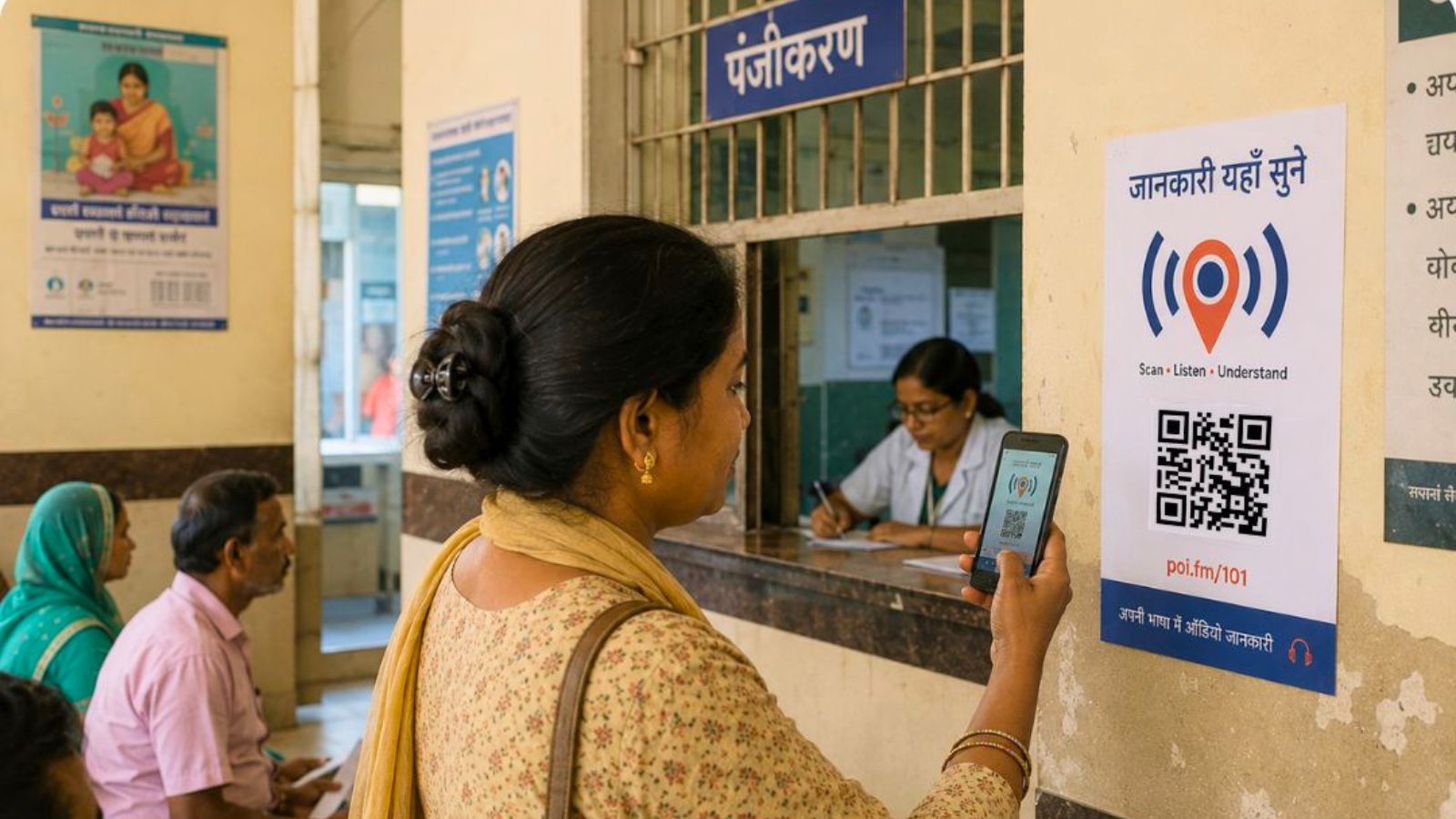
Perhaps a health centre wants to explain how its services work. A community organisation needs to inform people about a local programme. Or an NGO wants to provide simple instructions at a distribution point.
These messages may be short and highly specific to a particular place. They don't necessarily belong in a global knowledge library. But they can make a real difference to the people who need them.
And ideally, the organisations themselves should be able to create them.
Removing the production bottleneck
Creating audio traditionally involves several steps: writing a script, finding someone to record it, producing an audio file, uploading it somewhere, and making it accessible to listeners.
For a small community organisation, this can be surprisingly complicated.
We have spent years helping partners overcome these barriers. Through Audiopedia Academy, we share methods and practical guidance for audio-based community communication.
But there is a limit to how much we can support directly. We are a small foundation, and our ambition has never been to become a central production agency for everyone who wants to use audio.
The real challenge is to make audio publishing simple enough that organisations no longer need us to do it for them.
That is why we built POI.fm.
From text to spoken information in a few steps
POI.fm is a simple self-service publishing tool.
You write a short message, choose a language and listen to a free text-to-speech preview. If you're happy with the result, you can publish it.
POI.fm generates a stable web address, a QR code and a printable sign. Anyone scanning the code can listen to the message directly on their phone, without installing an app.
There is no account to create, no recording equipment to buy and no audio software to learn.
We're starting in India, where POI.fm currently supports English and Hindi. Publishing costs ₹999 (approximately US$11) per message, including five years of hosting. Messages can contain up to 1,500 characters, and previewing is free.
We're also planning to bring the service to other regions, expanding gradually as we learn from real-world use.
The idea is deliberately modest: one message, one link, one QR code.
But that may be all a local organisation needs to make an important piece of information accessible.
A different approach to scaling impact
Audiopedia.org will continue to provide free, curated educational audio. POI.fm serves a different purpose: it allows organisations to publish their own messages, using their own knowledge of local needs.
The organisation remains responsible for what it communicates, including the accuracy and appropriateness of the information. The technology simply makes it easier to turn that information into something people can listen to.
For us, this is an important step.
We have always believed that sustainable development requires local ownership. The same should be true of digital communication. Local organisations should not have to depend on an international technology provider every time they want to publish a short audio message.
And for a small foundation like ours, creating tools that others can use independently is perhaps the most promising way to scale our impact without continuously expanding our own operations.
POI.fm is still at an early stage. We are starting with a very simple publishing model and a deliberately limited set of features. There is much to learn about how organisations will use it in practice.
But the direction is clear.
For years, we have worked to make knowledge easier to access. Now we want to make it easier to share.
Explore POI.fm at poi.fm.